



The Hunter’s Rest — A Young Aristocrat with His Dogs
French School, 18th century, circa 1740
Circle of Nicolas Lancret (1690–1743)
Oil on canvas
Canvas dimensions: 17.32 × 21.26 inches (44 × 54 cm)
Carved and giltwood frame in the Louis XV style
Framed dimensions: 25.20 × 29.13 inches (64 × 74 cm)
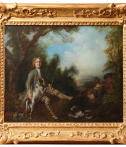
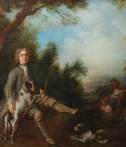
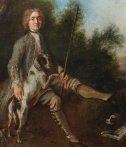
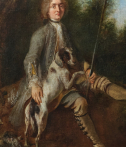
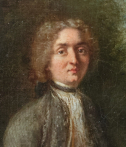
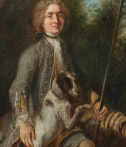
In a woodland clearing shaded by mature trees, a young aristocrat pauses to rest with his dogs. Seated at the foot of a tree, his torso upright and one leg elegantly extended, he turns a youthful, self-assured gaze toward the viewer. His long gray coat, open over a golden-toned waistcoat, white cravat, and tall gaiters form a notably refined hunting ensemble. The ease of his pose and the care of his dress lend this pastoral scene the distinction and immediacy of a portrait.
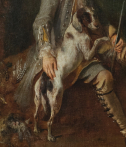
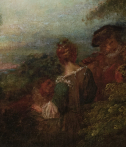
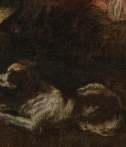
A white-and-brown dog rises affectionately against him, its forepaws resting on his thigh, while a second reclines in the foreground. The nearly upright sporting gun, together with the game and hunting accessories arranged on the ground, establishes the setting. In the background at the right, a young woman seen from behind and a figure playing the flute quietly enliven the woodland, introducing a note of music and gallantry to this moment of repose.
The landscape opens onto a broad expanse of blue sky crossed by pale clouds. Dark masses of trees frame this luminous vista, setting off the young aristocrat’s silhouette. The silvery grays of his coat, warm earth tones, and muted greens create a delicate harmony, enlivened by the bright whites of lace and the dogs’ coats.
Attribution to the artist frome the Circle of Nicolas Lancret
In both subject and composition, this painting belongs to the artistic world of Nicolas Lancret’s elegant hunting scenes. Rather than depicting the pursuit itself, it presents a leisurely interlude in which aristocratic refinement, the companionship of dogs, and the pleasures of the landscape take center stage.
A particularly relevant comparison is La Halte de chasseurs, offered at Christie’s and dated in its catalogue entry to around 1740 or shortly thereafter (oil on canvas, 86 × 107 cm; Christie’s, New York, January 27, 2000, lot 15). That composition likewise brings together a hunter seated beside a tree, his sporting gun, dogs, and game. The connection lies less in a direct repetition of the arrangement than in a shared conception of the subject: an elegant figure at ease, whose relaxed bearing and interaction with his dogs form the living heart of the painting.
Picnic after the Hunt, in the National Gallery of Art, Washington, and dated circa 1735–1740, offers a further parallel in its union of hunting and fashionable sociability (oil on canvas, 61.5 × 74.8 cm; Samuel H. Kress Collection, accession no. 1952.2.22). The secondary figures in the present painting evoke a similar spirit, transforming the clearing into a setting for companionship as well as a resting place after the hunt.
A Lightness of Touch and an Atmospheric Landscape
The association with Lancret’s circle is further supported by the painting’s handling. Supple brushwork brings movement to the fabrics and the dogs’ coats, while small highlights illuminate the cravat, cuffs, folds of the coat, and details of the figure. The result retains a sense of spontaneity while preserving the composition’s underlying elegance.
The treatment of the foliage is especially effective in creating atmosphere. Rather than describing individual leaves, the artist suggests the canopy through soft, irregular masses. Light touches animate its edges, while blended passages and effects of transparency create subtle transitions between foliage and sky. Branches emerge and disappear within the leafy forms, lending depth to the woodland.
In these passages, the paint appears thin and airy, contrasting with the stronger accents that define the tree trunk, the central figure, and the foreground. This interplay unites the figures with their surroundings and contributes to the scene’s enveloping charm.
Taken together—the galant composition, the sitter’s effortless bearing, the affectionate presence of the dogs, the supple brushwork, and the atmospheric landscape—these qualities support an association with the circle of Nicolas Lancret.
Nicolas Lancret (1690–1743)
Nicolas Lancret was one of the leading painters of the fête galante and a celebrated interpreter of French elegance under Louis XV. Trained first by Pierre Dulin and later by Claude Gillot, he drew inspiration from Watteau while developing a distinctive style marked by lively brushwork, shimmering color, and an engaging sense of narrative. Admitted to the Royal Academy of Painting and Sculpture in 1719, he depicted the pleasures of aristocratic society: balls, concerts, country gatherings, and leisurely hunting parties. Admired by distinguished collectors, including Frederick II of Prussia, he also received royal commissions for Versailles and Fontainebleau. His paintings remain vivid expressions of the grace and cultivated sociability of eighteenth-century France.