

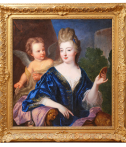


Portrait of a Lady as Venus, studio of François de Troy, late 17th century French school
22 000 €Portrait of a Lady as Venus with Cupid Combing Her Hair
Workshop of François de Troy (1645–1730)
Paris, late 17th century, circa 1695
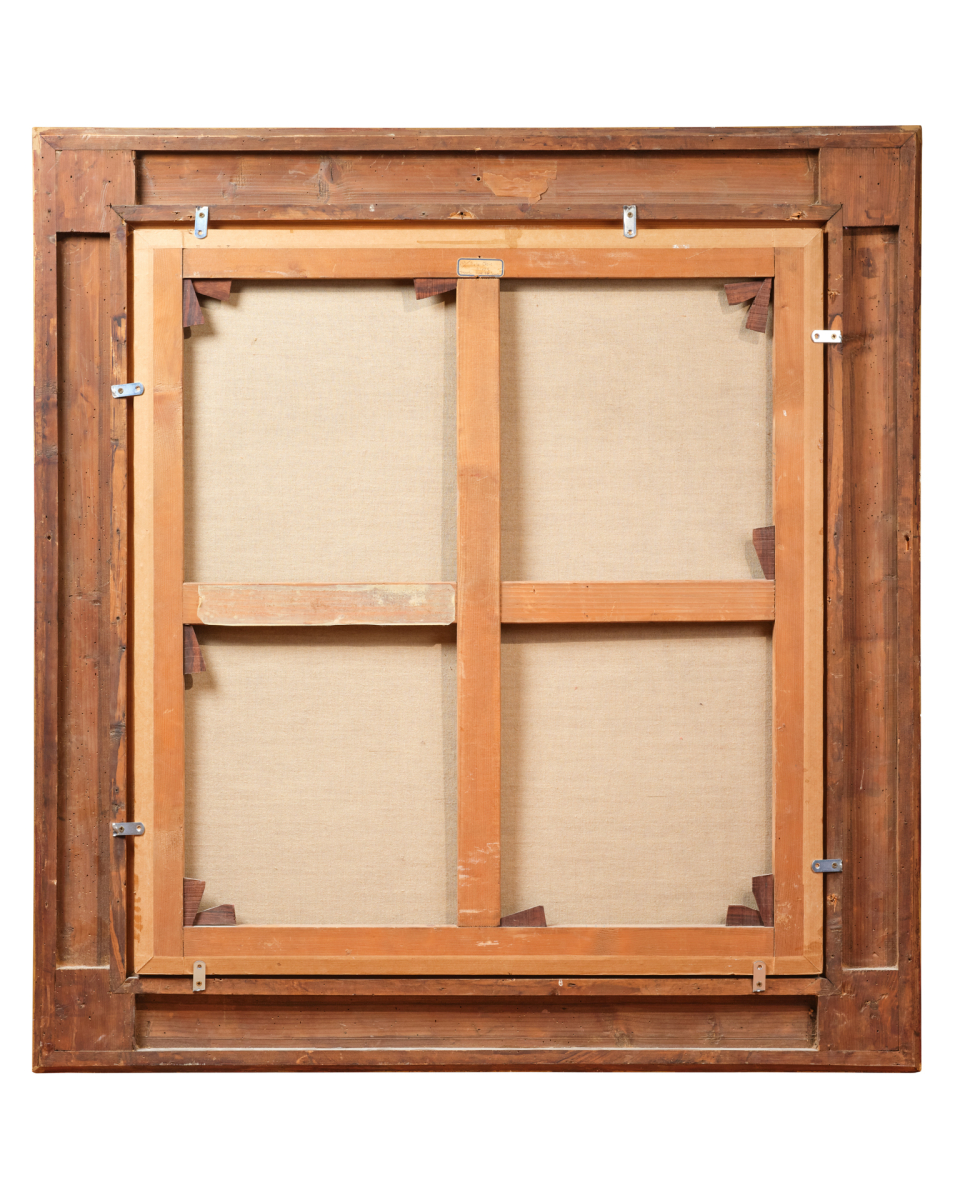
Carved and gilded wooden frame in the Louis XIV style
Dimensions
Canvas: H. 89 × W. 83 cm, (35.04 × 32.68 inches)
Framed: H. 116 × W. 107 cm, (45.67 × 42.13 inches)
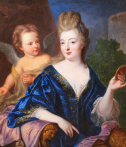
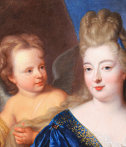
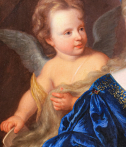
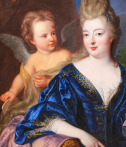
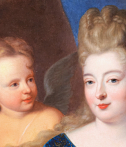
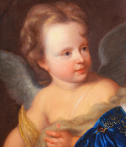
The brilliance of the blue velvet, the freshness of the flesh tones and the splendour of the draperies lend this portrait a remarkable presence. The young woman is depicted as Venus, holding a mirror while Cupid combs her hair. This delicate gesture, which makes the god of love himself an attendant to her beauty, lends the composition a particular grace.
This mythological guise belongs to the tradition of the portrait historié, especially favoured within princely and aristocratic circles: the sitter retains her individual features while assuming the identity and attributes of a deity. Louis XIV himself identified with Apollo, the sun god, drawing upon this association to cultivate his image as the Sun King. In female portraiture, identification with Venus offered a means of celebrating the sitter’s beauty and distinction through an allegorical presentation.
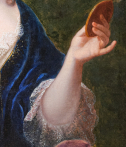
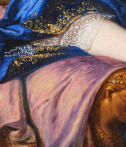
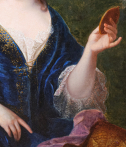
The lapis-blue velvet gown is one of the painting’s principal attractions. Its deep tones are enlivened by luminous highlights that follow the movement of the fabric. The folds alternate between dark recesses and brightly illuminated ridges, conveying the weight of the velvet and its shifting lustre. The folds and creases of the sleeves are rendered with particular care: light catches their raised surfaces, softening through subtle transitions before giving way to shadow. Gold-thread embroidery bordering the neckline and sleeves stands out crisply against this intense blue.
The lilac mantle enriches this harmony with shades of pink and silver. Its broad folds envelop the figure and spread across the armchair, guiding the eye towards the face and hands. The depth of the velvet is counterbalanced by the pearlescent sheen of this drapery, whose changing colours suggest the play of light across its surface. White lace introduces a lighter note. At the neckline and cuffs, its delicate openwork stands out against the flesh and fabrics. Its finely detailed execution contrasts with the sweeping folds of the draperies, creating an interplay between intricate passages and broader forms that brings the composition to life.
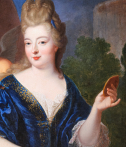
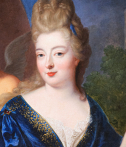
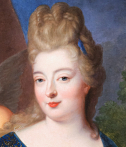
The freshness of the face echoes the brilliance of the clothing. The fair flesh tones are warmed with pink on the cheeks and lips, while soft shadows model the eyelids, nose and chin. Light extends across the neck, décolletage and arms, maintaining the figure’s visual unity. The direct gaze and slight smile preserve the sitter’s individual presence at the heart of this mythological presentation.
The hands, with their delicately drawn fingers, extend the elegance of the pose: one rests on the armrest, its slightly extended index finger introducing suppleness and movement, while the other holds a mirror, an attribute of Venus.
The armchair, with its arm supports carved as sphinx heads, introduces a classical note, while the red curtain and the opening onto landscape and architecture lend depth to the scene.
The artist demonstrates complete mastery in the rendering of materials, capturing with striking realism the lustre of velvet, the intricate detail of brocade, the pearlescent reflections of the lilac mantle and the lightness of lace.
Through its radiant colours, splendid fabrics and fresh flesh tones, this work offers a particularly appealing expression of portraiture under Louis XIV. Cupid’s delicate gesture as he combs the sitter’s hair brings tenderness and poetry to this refined composition. The harmony of blues and lilacs, the fineness of the lace and the luminous modelling of the face create an ensemble of considerable painterly richness. With its decorative impact and the charm of its subject, this portrait establishes itself as the focal point of a refined interior.
Related Works:
- François de Troy, Portrait of a Couple as Venus and Paris, 1691, oil on canvas, H. 150 × W. 120 cm. Paris, Musée du Louvre, inv. RF 1942 4.
- François de Troy, Portrait of the Countess von Cosel and Her Son as Venus and Cupid, circa 1712–1715, oil on canvas, H. 148.6 × W. 115.6 cm. Raleigh, North Carolina Museum of Art, inv. G.67.22.2.
François de Troy (Toulouse, 1645–Paris, 1730)
François de Troy ranks among the leading portrait painters of Louis XIV’s reign. Sought after by princely and aristocratic patrons, he portrayed members of the king’s family and their children. A subtle colourist, he is distinguished by the softness of his flesh modelling and the refined rendering of fabrics. In the 1690s, he also became principal painter to the court of James II, the deposed King of England, living in exile at Saint-Germain-en-Laye.