

Crucifixion, studio of The Master of the Female Half-Lengths (active 1500-1550), 16th century Antwerp school
17 500 €Crucifixion, studio of the Master of the Half-Figures (Antwerp, active 1500-1550)
Antwerp School, mid-16th century
Oil on carved oak panel (central panel of the triptych), h. 88 cm, w. 59 cm
Original frame, framed: h. 98 cm, w. 68 cm
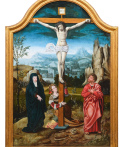
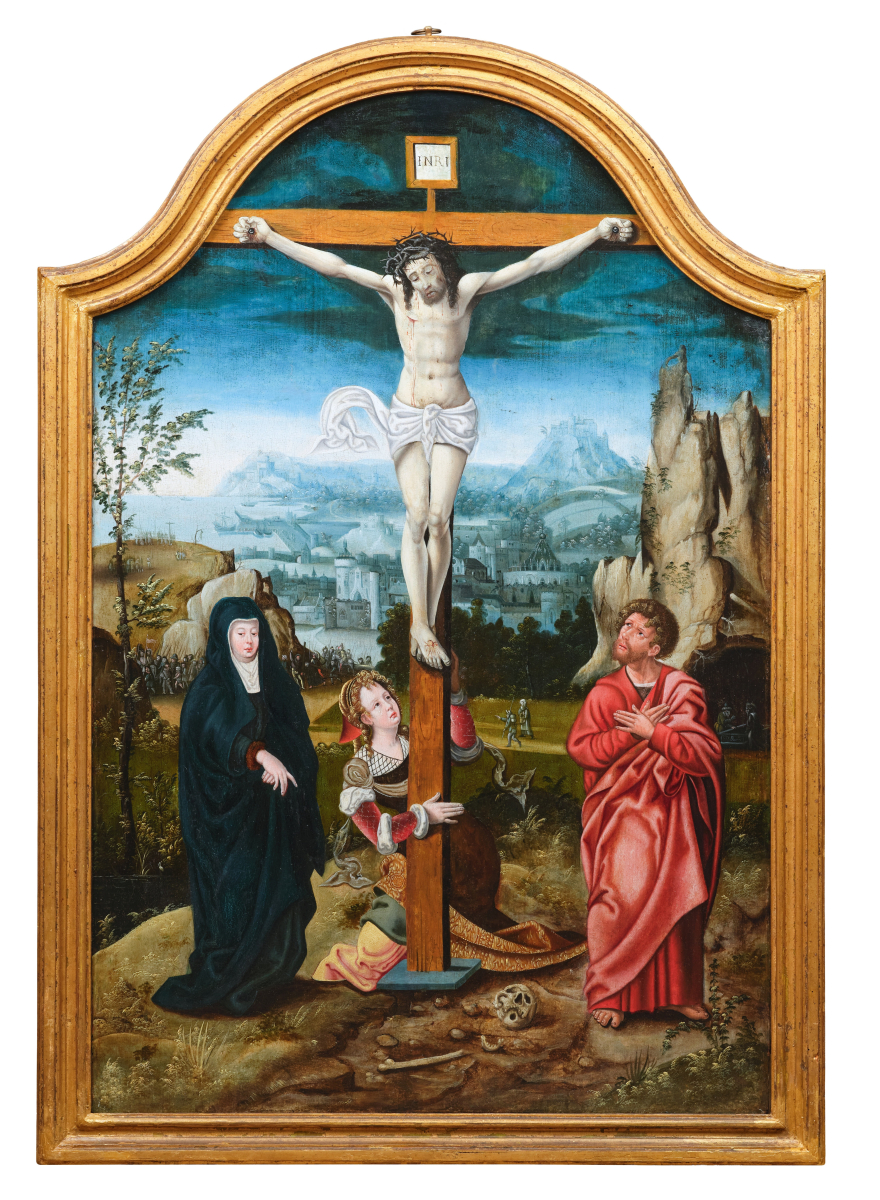
A rare example of Antwerp painting from the first half of the 16th century, our Crucifixion captivates as much by the quality of its expansive river landscape as by the delicacy of its figures and the brilliance of its palette. The richness of the colors, the balance between devotion and narrative, and the subtlety of the atmospheric effects make it a particularly representative work of the artistic refinement developed in the workshop of the Master of the Half-Figures. Through its remarkable synthesis of the world-landscape inherited from Patinir and the expressive gentleness characteristic of the Master of the Half-Figures, this composition stands out as a particularly accomplished example of the Antwerp Flemish Renaissance.
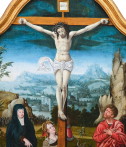
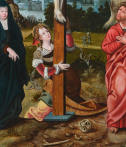
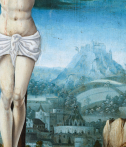
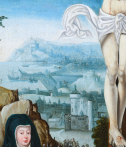
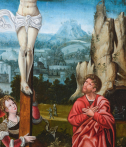
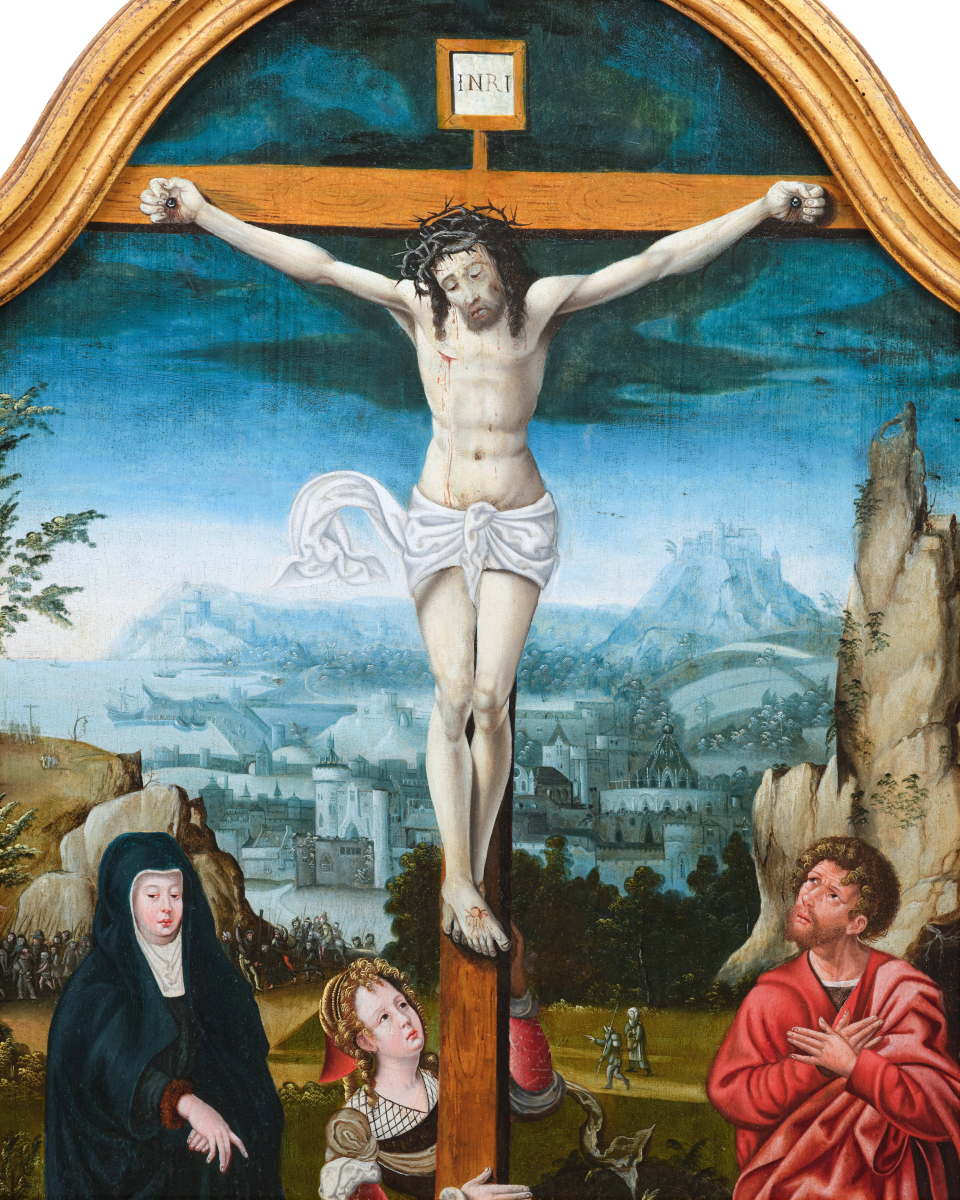
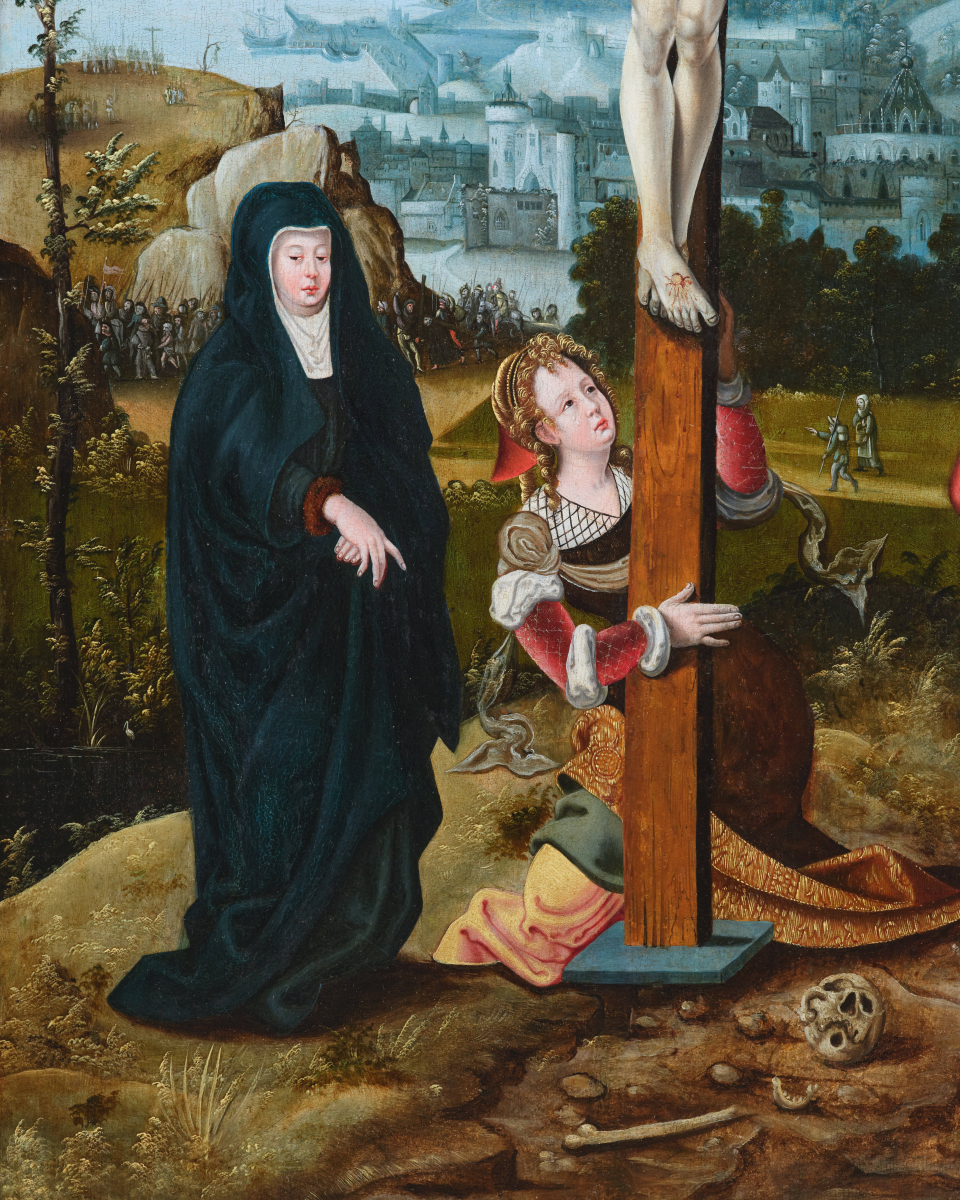
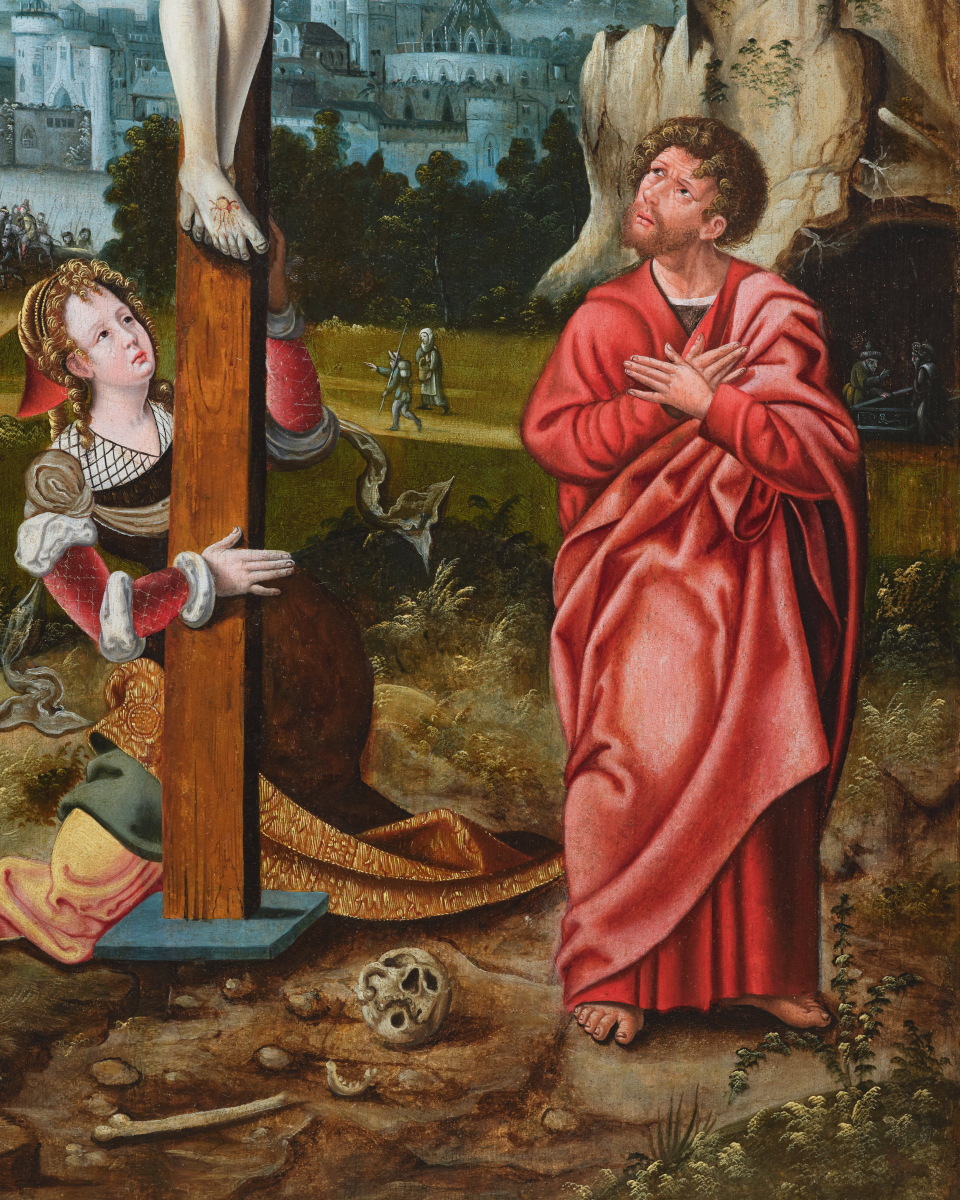
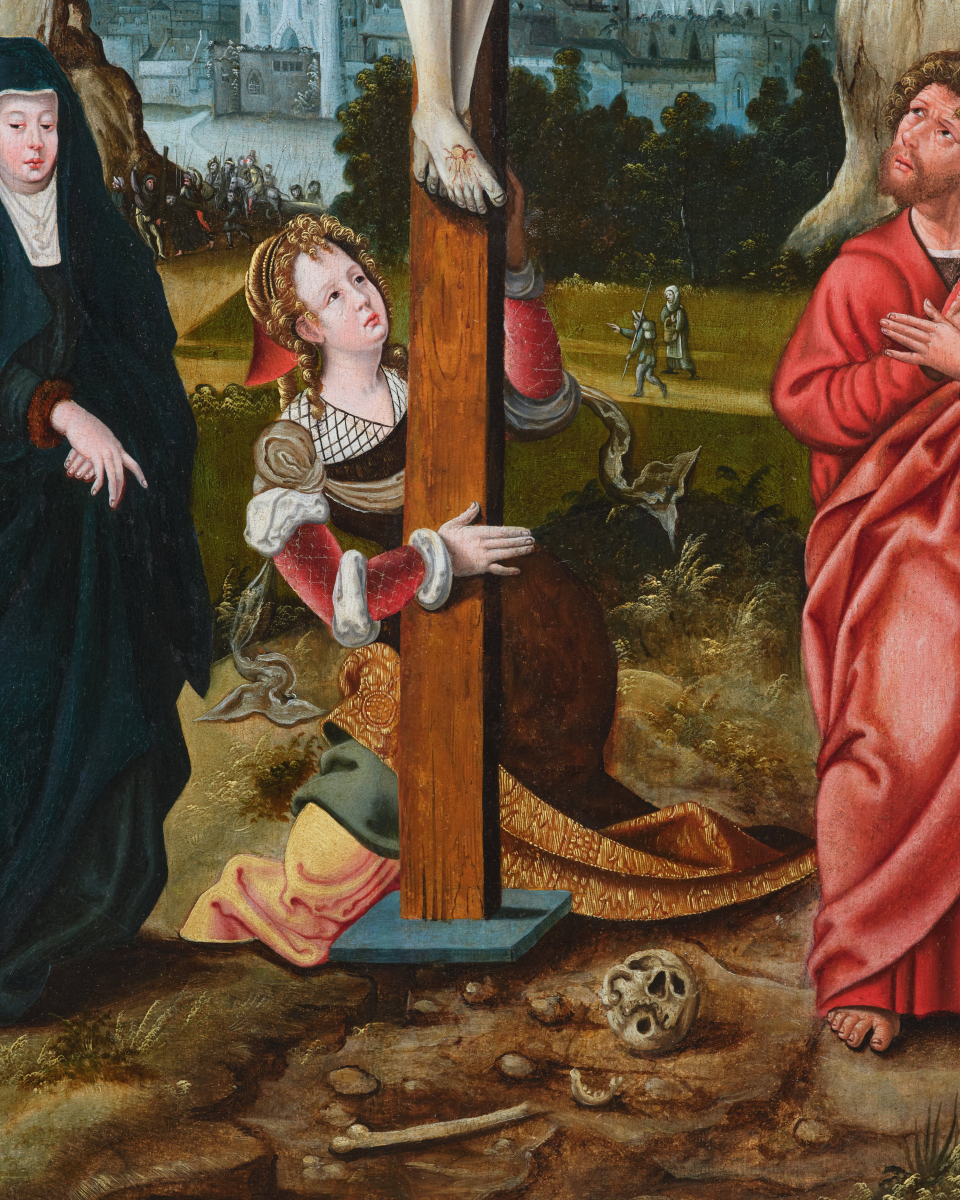
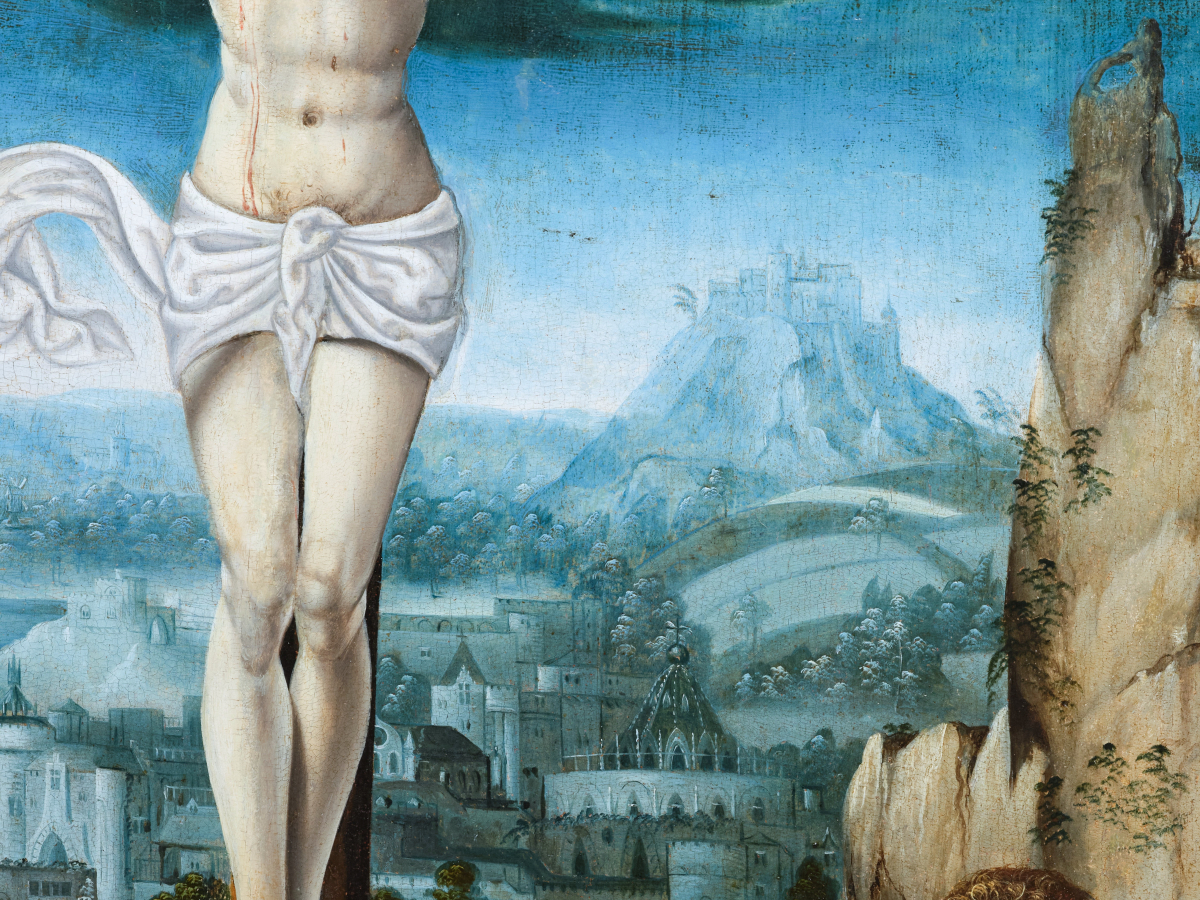
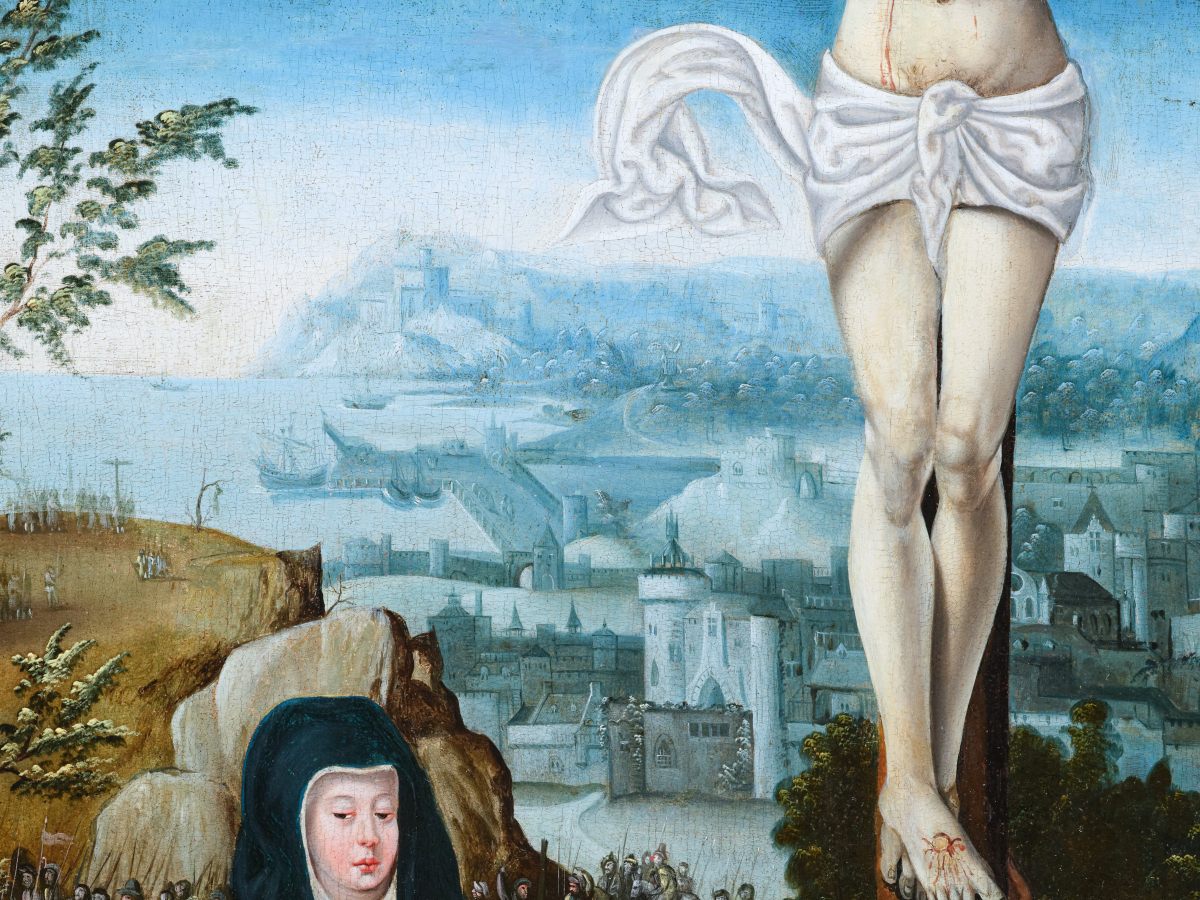
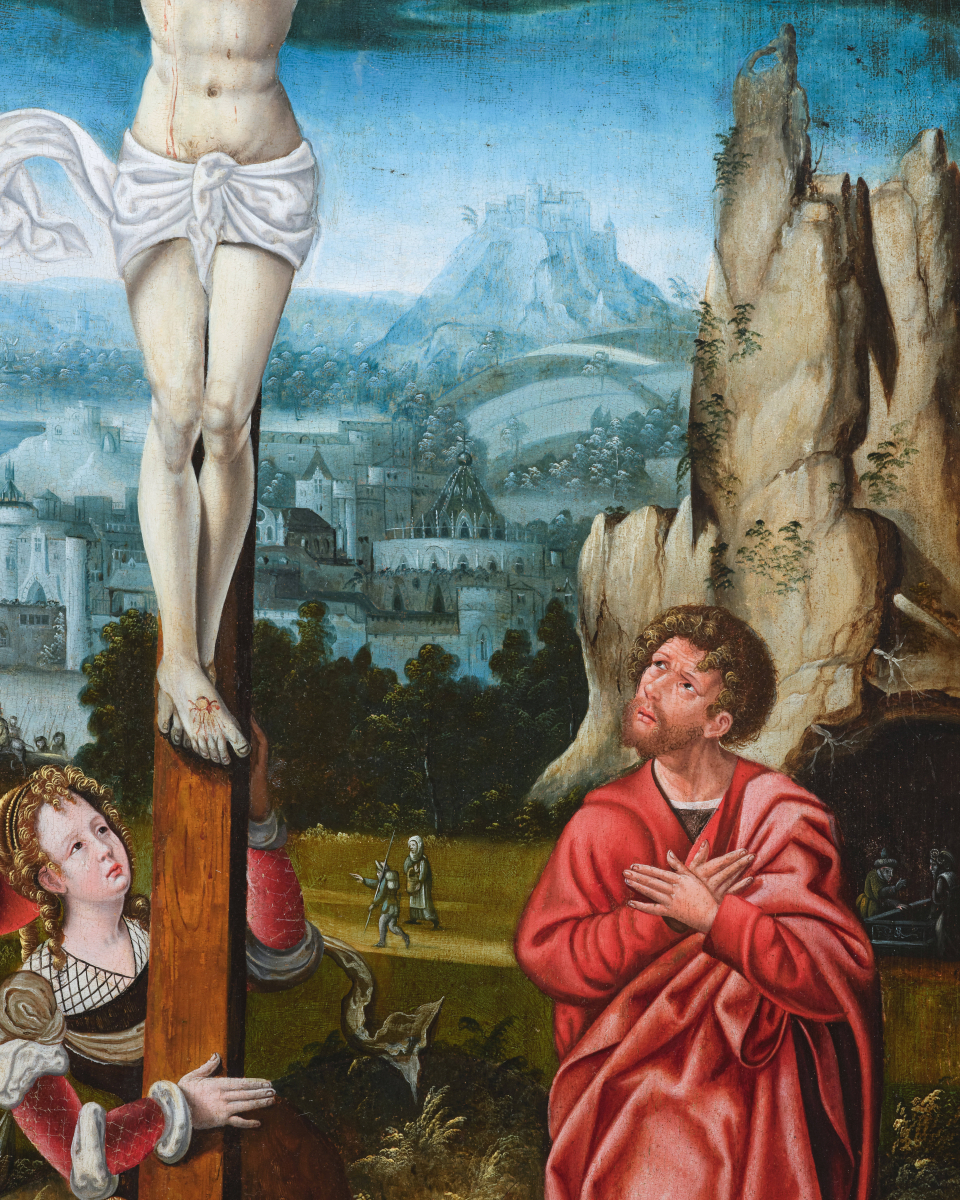
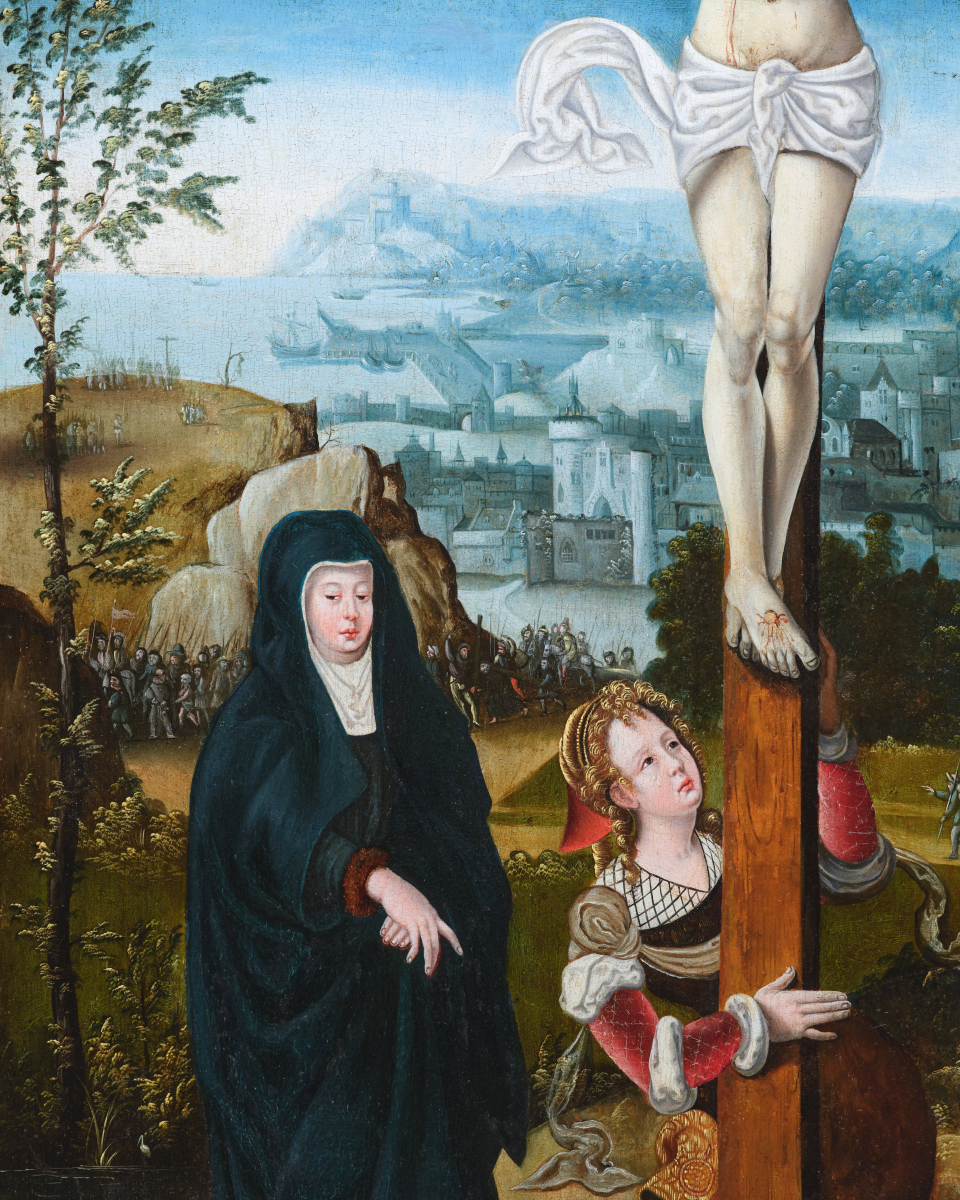
Our painting of the Crucifixion is organized around the central figure of Christ nailed to a high cross erected atop Golgotha. His slender, pale body stands out against a blue-green sky that lightens towards the horizon, creating an atmospheric depth characteristic of Flemish painting of this period. The bowed head, encircled by the crown of thorns, expresses agony in a restrained pose. The white loincloth, tied at the front according to a recurring motif in the work of the Master of the Half-Figures, has one end drawn between the legs before billowing outwards in a movement lifted by the wind, subtly animating Christ's silhouette. At the foot of the cross, a skull and a few bones evoke Adam and the redemption of humanity through Christ's sacrifice.
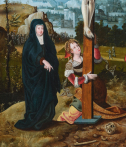
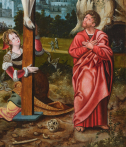
To the left stands the Virgin Mary, enveloped in a flowing blue-green mantle whose heavy folds accentuate her contemplative posture. Her pale face, framed by a white veil, expresses silent sorrow. Kneeling at the center of the composition, Mary Magdalene embraces the cross in a gesture of fervent devotion, while to the right, Saint John, clad in a richly textured red cloak, gazes up at Christ, his hands folded across his chest. Contrary to the iconography typically found in 16th-century Antwerp workshops, he appears here as a bearded, middle-aged man. This relatively rare characteristic, however, is found in several works by the Master of the Half-Figures.
The Virgin's face displays the typical characteristics of the Master of Half-Figures' repertoire : a high forehead, full cheeks, a rounded chin, and a gentle expression tinged with restrained melancholy. This youthful, feminine physiognomy is found in numerous depictions of Virgins, Magdalenes, and other saints from his workshop. The figures are also distinguished by their smooth complexions, elegant proportions, and attention to the richness of the fabrics, favoring formal refinement over dramatic expressiveness.
The background unfolds according to the world-landscape formula inherited from Joachim Patinir. A vast panorama, blending a fortified city, estuary, winding paths, rocky outcrops, and bluish hills, stretches behind the sacred figures. At the heart of this lively river landscape, a small port, quays, and several boats also appear, their silhouettes punctuating the waterway and testifying to the attention paid by Antwerp painters to the commercial and maritime activities that ensured the city's prosperity. The composition is structured by a succession of narrative planes that invite the viewer's eye to move through the image as a continuous story, a technique characteristic of Antwerp painting in the first half of the 16th century. Behind the main scene appears the episode of the Carrying of the Cross, depicted by a group of soldiers and horsemen, with Golgotha rising on the mountain to the left, while to the right, in a grotto carved into the rocks, unfolds the Entombment of Christ. This multifaceted narrative, integrated into the landscape, enriches the meditative dimension of the work while highlighting its kinship with the inventions of Patinir.
The attribution to the workshop of the Master of the Half-Figures seems all the more plausible given that several art historians, notably Robert Koch and Walter Gibson, have emphasized the close links between this artist and Joachim Patinir. Long considered primarily the creator of half-length portraits of Mary Magdalene and young women reading, writing, or playing music, the Master of the Half-Figures directed a particularly active workshop in Antwerp that also produced devotional works and altarpieces. His role as a landscape painter has, however, been gradually re-evaluated, with several compositions formerly attributed to Patinir now being attributed to him. Koch even went so far as to suggest that he began his career in Antwerp as Patinir's assistant or pupil, a hypothesis based on the stylistic similarities of their landscapes and the reuse of certain models by the master. This connection is evident here in the depth of the landscape's construction, the atmospheric perspective, the rugged rocky reliefs, and the importance given to the secondary narrative scattered throughout the panorama.
Finally, certain details of the composition directly recall recurring motifs in the corpus defined by Koch. He notably noted the reappearance of comparable groups of soldiers in the Landscape with Scenes from the Life of Saint John the Baptist at Uppsala University and in the Saint Jerome at the Kunsthaus Zurich. These correspondences, combined with the feminine type of the Virgin, the unusual presence of a bearded Saint John, and the quality of the landscape, allow us to cautiously but convincingly suggest an attribution to the workshop of the Master of the Half-Figures, or at the very least to an artist belonging to his immediate circle. An
anonymous painter of the first half of the 16th century, the Master of the Female Half-Figures, conventionally dubbed as such by Max Friedländer at the beginning of the 20th century, devoted himself to the representation of female figures, generally half-length, inspired by biblical and classical episodes. Primarily active in Antwerp and Mechelen around 1525-1550, he also depicted episodes from the life of Christ and aristocratic figures, playing an instrument or reading in wood-paneled interiors.
Related works:
- Master of the Half-Figures, The Triptych with the Crucifixion, circa 1520-1530, Sabauda Gallery, Turin
- Master of half-figures, the Crucifixion, Rotterdam, Boymans van Beuningen Museum
- Master of the Half-Figures, The Deposition, Sotheby's London sale, 3/4/1985, lot no. 34
- Master of the Half-Figures, The Lamentation, Church of Saint Salvador, Ubeda, Spain
The Master of the Half-Figures (active in Antwerp 1500–1550)
The Master of the Half-Figures is the conventional name given to an anonymous painter, or more likely to a particularly important workshop, active in the Low Countries during the first third of the 16th century. His name derives from a series of half-length portraits of Mary Magdalene and elegantly dressed young women engaged in reading, writing, praying, or playing music, which enjoyed great success with an international clientele. Art historians now consider this body of work to be the product of a prolific workshop, probably based in Antwerp, then the main artistic and commercial center of the Southern Netherlands.
Long perceived as merely a painter of refined female figures, the Master of the Half-Figures is now recognized as a remarkable landscape painter. Several landscapes formerly attributed to Joachim Patinir are now associated with him due to their stylistic similarities. The research of Robert Koch and later Walter Gibson highlighted the quality of his vast river panoramas, characterized by fantastical rock formations, miniature cities, atmospheric perspective effects, and a narrative unfolding across several successive planes.
According to a now widely accepted hypothesis, the artist began his career in Antwerp in the immediate circle of Joachim Patinir, perhaps even as an assistant in his workshop. This proximity would explain the profound influence Patinir exerted on his entire landscape oeuvre, as well as the reworking of certain compositions by the master, notably Saint Jerome in the Desert. Koch even suggested that the Master of the Half-Figures trained in Patinir's workshop around 1520.
The workshop also produced altarpieces and devotional paintings, often combining sacred figures with expansive landscapes. We also know that the Master of the Half-Figures collaborated with other Antwerp artists: a documented example shows him creating the background landscape for a Virgin and Child painted by Jan Gossaert, now in the Cleveland Museum of Art and dated 1532, which constitutes one of the few reliable chronological markers for his activity.
His style is characterized by female faces with soft, rounded features, luminous complexions, great attention to luxurious fabrics and precious details, as well as a marked taste for meticulously observed landscapes. These qualities explain the enduring popularity of this workshop, considered by Max J. Friedländer to be one of the most prolific and influential of the Antwerp Renaissance.
Bibliography:
M.-J. Friedländer, Die Altniederländische Malerei, 1935, vol. XII